The question of what women can and can’t do in the church is a perennial one, and has been particularly topical recently: the much-publicised SBC vote—taking the first of two steps towards barring churches that appoint female pastors—and the CofE’s appointment of their first female Archbishop. The same question has been answered from my own small corner of Christendom, albeit far more quietly. The answer matters. But so, too, does the process that arrived at it. How church leaders respond to this topic reveals how they actually read the Bible, how they turn what they profess into practice, and whether the two are consistent. These are what this series sets out to examine.
In late 2025 New Ground’s Core Team released a Theological Paper, “For the Sake of the World,” which was intended to describe how men and women should relate to one another in our churches, with a particular focus on leadership roles. The paper was accompanied by a separately commissioned Listening & Learning Report. Together, they were presented as the outcome of a two-year process.
I want to be clear at the outset about the standard I’ll be using, because it isn’t mine. New Ground have been unusually explicit about how they say they work: about how this process was run, and—within the paper itself—about how Scripture is to be read. At every stage in this series I’ll hold them to those statements; I won’t be measuring them against a standard of my own. I’m not asking whether New Ground arrived at the answer I would have given. I’m asking whether they arrived at theirs the way they said they did.
Part 1 is therefore about the record—the facts of the matter—rather than the theology (which I’ll turn to from Part 2 onwards). Before we can ask whether the paper meets its own standard, we need to know what New Ground said they were doing, and what their own materials say actually happened.
A Woman’s Intuition
“My fear is that with this paper, what’s going to happen is ‘here’s the decision – here’s what we need to do’ and no space for conversation, reconciliation and a recognition that this has been painful and wrong. How do we actually process it?”
These words were spoken by a woman within the New Ground family of churches, during a confidential interview (anonymised by the report’s author through composite personas, so that nobody could be identified). She spoke these words before the paper in question had been published, and they appear in a report that New Ground themselves commissioned. She was describing, in advance, what she expected the outcome of a two-year process might be, whilst still in the midst of it.
Here is how New Ground describes the beginning of that same process, in the introductory video which was released alongside the finished documents:
“Our starting point was a theological paper.”
She feared the paper would arrive as a decision already taken. By New Ground’s own account, it did.
New Ground
For readers who may not know, New Ground is a self-described “family of churches”, led by James Silley and the rest of the Core Team: Dave Holden, Dale Barlow, Henk Kersten and Jim Partridge. New Ground is a ‘sphere’ within the wider Newfrontiers network, which the New Ground website describes as “a network of church families” (under ‘About us’ > ‘Newfrontiers’), but which Newfrontiers itself describes as “a group of apostolic leaders.” Like the rest of Newfrontiers, New Ground holds a complementarian theological position (though with an interesting nuance, which turns out to matter a great deal later on): men and women are equal in worth before God, but different in role; with the office of elder specifically reserved for men.
On a dedicated web page, which I’ll talk more about in a moment, New Ground describe a process: “a family-wide journey exploring how men and women can best flourish together in leadership and mission” conducted, notably, “over the past two years.” Three things came out of it:
- A Theological Paper: “For the Sake of the World: Flourishing Together as Men and Women Within our New Ground Church Family”, which sets out New Ground’s convictions on eldership, teaching, and the roles of women and men; alongside a shorter “Executive Summary”. These are the documents that Part 2 of this series will begin to examine closely.
- A Listening and Learning Report: Written by Barbara Macnish, an independent leadership consultant who has worked with church leaders since 2012, many of them within Newfrontiers. She conducted the interviews alongside Rachel Hobson, a member of the leadership team in a New Ground church.
- A Table on Complementarity: A new, ongoing group intended to help New Ground’s churches align practice with theology, led by Emma Hosier.
The chronological sequence is worth setting out. New Ground’s own materials date the start of the process to late 2023, and their introductory video credits the Core Team, as it then existed, before James Silley took over leadership from Dave Holden in mid-2025. Barbara Macnish signed off her report in October 2025. The Theological Paper was finalised the following month, marked “Version 3.3 – Final” (the numbering implying several earlier rounds of revision), and James Silley added his foreword to Macnish’s report in that same month. So, two years of process; a report completed in October; and a paper finalised in November. Whatever else one concludes about these documents, they were not hurried.
Before exploring what these documents say, it’s worth highlighting how you’re expected to find them.
The Documents
I’d encourage you to try this yourself, because a description doesn’t quite do it justice.
The Theological Paper and the Listening & Learning Report are not linked to directly from anywhere on New Ground’s website. There is a page, ‘Complementarity’, which sits in the site’s main navigation menu; so anyone browsing the New Ground website might come across it. But the page itself contains no direct link to any of the documents. Instead, you are instructed to watch an introductory video first. Only at the end of the video does a QR code appear, pointing to a shared folder where the documents actually live.
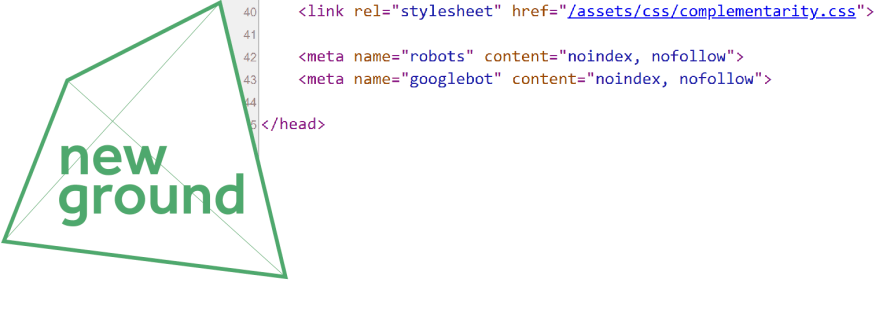
Interestingly, on checking the web page’s source code one finds explicit instructions in the meta data, telling search engines not to index it, and not to follow any links from it (“noindex”, “nofollow”). The instruction is given twice: once as a general directive to any search engine, and once addressed specifically to Google. These are the kind of meta tags you’d expect on a private staff page, not on a public statement of theological conviction. If you search for the page directly, from a search engine, it doesn’t appear; though dozens of other New Ground pages—events, unrelated blog posts, media archives—will surface without any difficulty. The practical effect of all this is specific, and should be stated clearly: someone already browsing New Ground’s website might find this, but anyone else, who may have heard something and simply goes looking for it online, will not.

Then there’s the video, which I was eventually able to obtain an accurate transcript of (none of the usual options were available, so I ran it through a transcription service). The runtime is around eleven minutes, and it comprises about 1,650 words in total. Of that, the description of the Theological Paper—its title, its content, its conclusions—takes up roughly 150 words (that’s less than 10% of the word count), delivered in under a minute. Discussion of the Listening & Learning Report, however, gets over 6 minutes and runs to nearly 900 words. It covers the report’s methodology, its use of anonymised composite personas, an extended pastoral framing on how to receive potentially painful material, and a breakdown of its recommendations. This weighting (a ratio of about 1:6) is worth naming plainly, especially in light of what the practical outcome of this entire initiative amounts to.
Also of interest is who gets named. Eight people are named in eleven minutes. The two presenters, James and Hannah, introduce themselves. Dave Holden and the Core Team—as it then was—are thanked for having started the process. And two men are thanked directly:
“…it was two men in particular who have really driven this process forward. They have not sought to impose their views, but have fought to create space for women’s voices to be heard… Thank you Dale Barlow and Brett Melville on behalf of many women in our family.”
Barbara Macnish is named too, and more than named: she appears on camera to introduce her report, explain her methodology, and account for her own recommendations; Rachel Hobson is named alongside her as having listened to the interviews. The Table on Complementarity—which gets only minimal air time itself—is introduced alongside the person who will lead it: Emma Hosier.
But, whereas Barbara Macnish’s name appears on her Listening & Learning Report, not one of the people named is credited with having written the Theological Paper. It is not attributed to anyone at any point in the video. Within the paper itself, authorship is credited only to the “New Ground Core Team” (who, we remember, are five men), and the Executive Summary carries no attribution at all beyond its date. The document which—as we’ll see—has no binding force has a visible, accountable author. The document that binds every church within New Ground does not.
Click here for the shared drive, where the documents can be accessed directly.
Two Sets of Weights
The Theological Paper contains the one conclusion that is binding on every New Ground church without exception—that eldership is closed to women—and the video gives it a few sentences. The Listening & Learning Report, which by its own account carries no doctrinal weight at all, gets most of the runtime; wrapped in careful emotional preparation for what you’re about to read. That division wasn’t incidental; it was the design. New Ground are unusually clear about it if you pay close attention.
The video’s account of the sequence is explicit: “Our starting point was a theological paper.” The listening exercise comes next, introduced with a single word that does a lot of work:
“Alongside this paper, we wanted to listen to the experiences of those from within our churches.”
“Alongside.” Not “informing”, or “shaping”; not “which then led us to…” Alongside: running in parallel.
Macnish’s report confirms the same thing:
“This paper [the Listening & Learning Report] does not explore the question of orthodoxy (what is right thinking) on this topic – that is being discussed in a separate paper” (Report, p. 6).
Her brief was the lived experience; the doctrine was settled elsewhere, by other people, and quite separately.
And when the video describes what the Theological Paper achieved, the verb is not “concludes” or “determines.” Rather, it’s that the paper “reaffirms our shared convictions.” New Ground’s website uses the same word: the paper “reaffirms that eldership is a role for qualified men while encouraging the full release of women and men…”
“Starting point”; “alongside”; “reaffirms”, twice. That is New Ground’s own account of what happened, stated multiple times across their own preliminary material. The theological conclusions were not the outcome of the process but its beginning, and the listening merely ran alongside them exactly as described.
The Recommendations
This brings me to the clearest test of what the Listening & Learning Report was actually allowed to change.
Towards the end of the Report, Macnish sets out her recommendations: “There are two sections – one for local leaders of New Ground churches and the other is for the New Ground Core Team to consider” (Report, p. 51). The second section sits under her own heading: “For the New Ground Core Team” (Report, p. 53), and includes ten recommendations.
Of the ten recommendations addressed to the Core Team, the second reads:
“Model the way, inviting female voices onto or alongside the apostolic team. Appoint a trusted woman to spearhead and oversee culture change for women and to bring a woman’s voice into the decision-making of the sphere.” (Report, p. 53)
I focus on this one because its outcome is the most precisely checkable: it produced a named person and a named body with a stated remit. Read closely, it includes two parts: (1) invite women onto or alongside the apostolic team; and (2) appoint a trusted woman, whose remit has two halves: to spearhead culture change for women, and to bring a woman’s voice into the sphere’s decision-making.
A year on from the report, the first part of this recommendation remains unanswered: the New Ground Core Team is still five men. (Admittedly, adding someone to an apostolic team is a matter of recognition and discernment, not merely a personnel decision, and a year is not long. But the Core Team’s composition is not fixed: it changed during this very process, when James Silley took over its leadership in mid-2025).
The second part of the recommendation was apparently met: Emma Hosier, a genuinely respected and experienced leader, was appointed to lead the Table on Complementarity, which is very nearly what Macnish asked for. But the video is explicit about what the Table is, and isn’t: “It’s not about making top-down decisions.” The appointment was made; but, without the decision-making element, it had been stripped of half its remit.
I want to be careful about what I’m claiming here. Something was done, and it’s worth saying so: the Table’s remit—of “fostering dialogue, creating resources and supporting churches”—answers Macnish’s recommendations on training and networking, and the Complementarity page, the Executive Summary and the paper itself go some way towards her first recommendation to the Core Team, which asked for clarity to be created and communicated publicly (Report, p. 53). Macnish herself says in the video that her recommendations are “not final answers, but starting points for reflection and discussion, and they’re entirely at your discretion for implementation”, so discretion had been granted, and was theirs to exercise. It’s also worth pointing out that it isn’t clear whether New Ground intended the Table as their formal response to Macnish’s second recommendation, described above; it would therefore be unfair to say they ignored her advice.
What I’d observe is narrower and, I think, harder to dispute: of everything that recommendation asked for, the only part that was delivered is the part that required no authority to change hands.
What Now?
I’m not suggesting bad faith on the part of anyone named here. Macnish’s report reads throughout as careful and often very courageous work. Emma Hosier’s appointment is also significant. New Ground commissioned a report that documents real pain in their own churches, and then published it, which many organisations might not have done. But let’s be clear about the findings:
- a two-year process which, on its own account, begins with the theology rather than arriving at it;
- a landing page that intentional viewers can find, but search engines cannot;
- an introductory video that spent six times as many words on the document with no binding force;
- a report whose author states plainly that doctrine was not hers to examine;
- and a recommendation for shared decision-making met only in the part that required no power to change hands.
Taken together, this is not the record of a process built to be changed by what it hears. It’s the record of a process which was built to arrive where it started, with the appearance of having listened along the way.
Which returns us to the woman quoted at the top of this piece, who said—long before anything had been published—what she feared the outcome would be: “…here’s the decision – here’s what we need to do…” (Report, p. 51).
Throughout this series, we’ll see that what happened to the process also happened to the theology. The Core Team did not reach their conclusions by the method they said they would use; they reached them by a method they never named. And at the points where something was actually decided—which of Paul’s commands still bind, which features of the first-century church carry across to today, which questions are closed to disagreement—the reasoning is simply not there. The Theological Paper reads as description from beginning to end, which is why it’s possible to finish reading it and feel persuaded… but to have actually been shown nothing.
That matters more than a disagreement about eldership. This is the document that carries the one conclusion binding on every New Ground church without exception, and the people bound by it have no way to check how that conclusion was reached. So the test throughout will be the one you have just watched me apply in Part 1: whether the actual working behind a judgement was ever set out.
Part 2 turns to the Theological Paper itself, then, not to ask whether its conclusion is right—I won’t offer a view on that for some time yet—but to explore something the Core Team have made it possible to check. In a section near the beginning, they set out exactly how they intend to read Scripture. Part 2 holds them to this specified standard.
Discover more from Paul S Baker
Subscribe to get the latest posts sent to your email.

