
I recently re-read Tom Wright’s Virtue Reborn, and have found myself recommending the book to others on a fairly regular basis. Although it’s aimed at a popular audience, the volume deserves serious reflection for at least two reasons: (1) the argument presented throughout is quite nuanced and therefore easily misunderstood, and (2) the practical application is the work of a lifetime! But it’s serious work, and work which is becoming increasingly more important, especially in a contemporary church climate which – at least from where I stand – seems more and more to favour charisma over character.
Before thinking through what the practical application looks like, a summary of Wright’s argument is in order. The book answers a question which has been on most Christians’ lips at some point (or at least at the back of their minds): “What now?” Once a person has made a commitment to Christ, how are they to live their lives? Part of the problem with the conventional responses to such questions, is the assumption that the important thing is done: you’ve made a decision, and you’re going to heaven when you die (an idea which Wright brilliantly dismantles in his most recent book, God’s Homecoming). The usual answers therefore tend to sit somewhere between “you don’t really have to do anything,” and “find out God’s plan for your life” (which usually involves helping others to become Christians too). But for those who take seriously what the Bible clearly teaches about the deep meaning of human life, the standard range of answers simply raise more questions. Surely being a Christian means more (though not less) than simply making a decision, and helping others to make the same decision themselves?
To fully grasp Wright’s argument, it’s important to remember that the genuine Christian life is about embracing the Kingdom of Heaven (the gospel which Jesus himself preached), by getting to work in the present, in anticipation of that Kingdom’s full and final establishment in the future. What’s often referred to as the “now and not-yet” nature of God’s Kingdom, means that the New Creation promised for the end of this age, has already begun. And Christians are (supposed to be) part of this new creation, both now and not-yet: being transformed into the image of Christ as we go. It’s precisely within this process of transformation that the importance of character becomes clear.
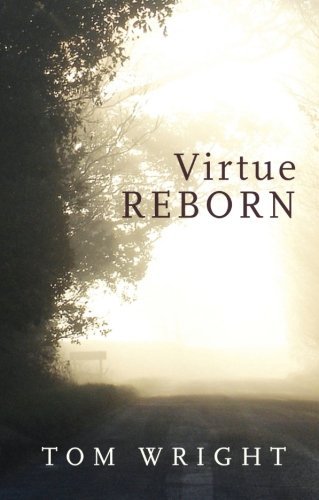
Wright points us back to Aristotle, who is credited with developing Virtue Theory. The idea is that in order for someone to fulfill their potential, they must train themselves toward that end. For Wright, Christian virtue is along the same lines, but operates in a far more real way. What Aristotle and similar thinkers could only point to in theory, Christian life can actually put into practice. The Christian ‘full potential’ is an active role in the New Creation. Training toward that end involves practising those habits of heart and mind which will bring forth the fruit of new creation life, in the here and now, to last into the not-yet. This is what Paul meant when he said, “if anyone is in Christ, this person is a new creation.” You are already, but you’re also becoming more so. And this is why he could also say “the good that I want, I do not do, but I practice the very evil that I do not want.” Because it’s a process, we should expect that it’ll take time to form the right habits (virtues), and to rid ourselves of the wrong habits (vices).
Whenever I’ve taught Virtue Theory, one of the major misconceptions amongst students is that vice is the opposite of virtue. On the face of it, this makes sense. Virtues are good; vices are bad. But there’s more to it than that: vices sit on either side of a virtue, like ditches on either side of a narrow road. The challenge of virtue is to avoid the ditch – but not go so far to the other side that you fall into the other ditch! Courage, for example (one of the so-called ‘cardinal’ virtues), has a vice of deficiency on one side (not enough courage: cowardice) and a vice of excess on the other (too much courage: rashness). Or consider generosity: too little and you’re a miser; too much and you’re wasteful. Character is developed when we successfully navigate virtue without falling for the associated vices. This way, the right habits are practised so that, over time, they become second nature: part of who we are. Our character.
The Christian approach to character development is tied to the uniquely-Christian end goal. Knowing where we’re going will determine what virtues we need to get there. By practising these virtues on the way, they begin to come naturally to us, and ultimately become a part of who we are: a new creation, in preparation for the coming New Creation. The genius of Wright’s argument is that it grasps the importance of the Holy Spirit, within the Christian community; which is what makes this entire process a reality. It is quite literally, virtue reborn.
To better understand how this all plays out in day-to-day Christian life, it’s helpful to consider why it often doesn’t. This is what we’ll explore in part 2. We’ll find that the problems start when the assumed end goal isn’t what it should be, and are further compounded by misunderstandings around the nature of Christian virtue. We can then begin to think through possible answers for the Christian character crisis.
This blog is moving to substack, where you can subscribe to receive all future posts and access other resources.

